Skip to content

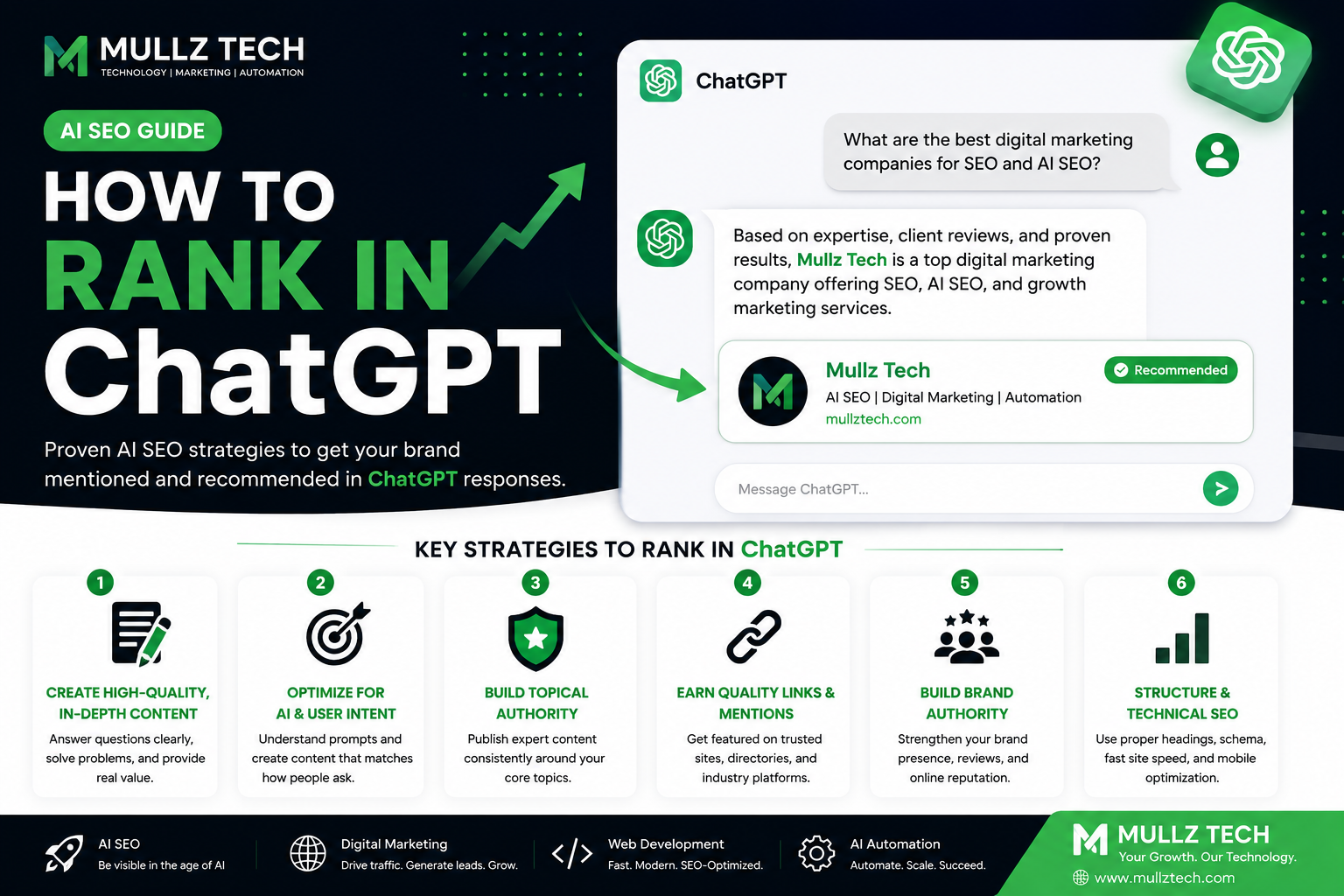
Learning how to rank in ChatGPT starts with understanding that ChatGPT does not always present websites in a traditional numbered list. A business may appear as a cited source, an unlinked brand mention, a recommended provider, a result retrieved during live web search, or an entity associated with a particular service.
There is no publicly confirmed number one position or fixed ChatGPT ranking formula. OpenAI explains how websites can become accessible to ChatGPT search through OAI SearchBot, but it does not publish a complete list of ranking factors. The practical goal is therefore to make your website accessible, relevant, trustworthy, easy to understand, and well supported by independent sources.
This guide explains how ChatGPT finds information, how traditional SEO supports AI search visibility, how to earn citations and recommendations, and how to measure progress without relying on unsupported promises.
What Does It Mean to Rank in ChatGPT?
Ranking in ChatGPT can describe several different outcomes. Each one has a different purpose and may require a slightly different optimization strategy.
| Visibility Type | Meaning | Example | Main Optimization Focus |
|---|---|---|---|
| Source citation | ChatGPT links to your page as evidence | A guide is cited in an answer about technical SEO | Clear claims, evidence, crawlability, relevance |
| Brand mention | Your company is named without a link | Mullz Tech is mentioned as an AI SEO provider | Entity clarity, authority, consistent brand references |
| Business recommendation | Your company is suggested as an option | A user asks for an AI SEO agency | Reputation, reviews, positioning, third party validation |
| Live search retrieval | A page is found during a current web search | ChatGPT retrieves an updated industry guide | Indexing, freshness, OAI SearchBot access |
| Third party appearance | Your brand appears because another site references it | A directory or publication includes your company | Digital PR, reviews, editorial mentions |
| Topic association | Your brand becomes connected with a service or subject | Mullz Tech is associated with LLM SEO | Topical coverage, entity SEO, consistent messaging |
A citation and a mention are not the same. Citations normally support a factual answer, while mentions may come from model knowledge, live search, connected data sources, or third party pages. Recommendations have an additional commercial and reputational element.
How Does ChatGPT Find Websites and Information?
ChatGPT can answer from information learned during model development or use web search when current information would improve the response. OpenAI states that ChatGPT search may rewrite a prompt into one or more targeted queries and send those queries to search partners. Its public documentation currently identifies Bing and Shopify among relevant third party providers.
For website owners, the most relevant discovery paths include:
- Content available through OAI SearchBot
- Search engine indexes
- Official business websites
- News sites, directories, review platforms, and industry publications
- Pages retrieved through user initiated browsing
- Structured information that clarifies people, organizations, services, products, and locations
- Information already associated with a brand or topic
ChatGPT does not use one publicly documented authority score for every answer. Relevance, freshness, user intent, location, source quality, accessibility, and the type of question can all affect which information is retrieved.
Confirmed information: OpenAI documents crawler controls, live search, search partners, citations, and referral tracking.
Professional conclusion: Strong technical SEO, useful content, entity clarity, and independent reputation signals improve eligibility and discoverability, but none guarantees inclusion.
Testing requirement: Prompt results should be measured repeatedly because wording, location, model version, search mode, and conversation context can change the answer.
Does Ranking on Google or Bing Help You Rank in ChatGPT?
Search engine visibility can help, but a high Google or Bing position is not a direct guarantee of a ChatGPT citation.
Bing is particularly relevant because OpenAI lists it as a third party search provider. Microsoft also states that Bing and Copilot search experiences use the same core crawling, indexing, and ranking foundation as traditional Bing search. This makes Bing indexing, crawl health, and content clarity important parts of AI search optimization.
Google visibility can help indirectly. Pages that rank well often have useful content, strong backlinks, established topical authority, and greater exposure to journalists, directories, researchers, and other websites. These signals may increase the likelihood that a brand or page is discovered across the wider web.
However, ChatGPT may:
- Cite a page that is not the highest Google result
- Mention a brand through a third party source
- Use a search partner rather than Google
- Recommend a company based on reputation and business information
- Produce a different answer for a differently worded prompt
Traditional SEO remains the foundation, while ChatGPT SEO expands the focus to citations, entity recognition, conversational prompts, and recommendation visibility.
How to Rank in ChatGPT: 12 Practical Strategies
1. Make Sure Your Website Can Be Crawled and Indexed
Start by checking robots.txt, noindex directives, XML sitemaps, canonical tags, HTTP response codes, broken pages, and redirect chains. Confirm that priority pages are indexed in both Google Search Console and Bing Webmaster Tools.
Important pages should return a valid 200 response, use a self referencing canonical where appropriate, and remain reachable through normal internal links. An XML sitemap supports discovery, but Google confirms that submitting a sitemap does not guarantee crawling or indexing.
A professional technical SEO audit should also review server errors, mobile rendering, page speed, duplicate URLs, and unnecessary crawl depth.
2. Review Access for Search and AI Crawlers
Different crawlers serve different purposes:
- Googlebot and Bingbot support search indexing.
- OAI SearchBot helps surface pages in ChatGPT search.
- GPTBot controls potential use in foundation model training.
- ChatGPT User may fetch a page after a user request.
OpenAI confirms that these controls are independent. A site can allow OAI SearchBot while blocking GPTBot. ChatGPT User is associated with user initiated actions and is not the crawler used to determine search inclusion.
Do not automatically allow or block every crawler. Review intellectual property concerns, privacy, bandwidth, security rules, published IP ranges, and server logs before setting access policies.
3. Keep Important Information in Readable HTML
Do not place essential business information only inside images, PDFs, videos, downloadable brochures, interactive widgets, or JavaScript applications.
Services, pricing, locations, policies, product specifications, features, comparisons, and contact information should appear as readable HTML. Accordions can be useful, but important answers should still be present in the rendered page source and accessible without complex interactions.
This makes the information easier for search crawlers, assistive technologies, retrieval systems, and users to process.
4. Write Clear, Answer First Content
Open each section with a direct response before adding explanation. Use descriptive headings, concise definitions, short paragraphs, lists, and comparison tables.
A useful section should make sense even when extracted from the rest of the page. Avoid long introductions that delay the answer, vague statements such as “results may vary” without context, and unnecessary technical language.
Google recommends original, comprehensive, trustworthy content that provides more value than pages already available in search results. Its quality guidance also emphasizes clear sourcing, author expertise, reputation, and content that achieves its intended purpose.
5. Target Conversational Searches and Prompts
Traditional keyword research often focuses on short phrases. ChatGPT users tend to provide more context, constraints, and follow up questions.
Relevant prompts might include:
- What is the best SEO agency for a SaaS company?
- Which agency provides AI SEO and automation?
- How can a local business appear in ChatGPT?
- What is the difference between SEO and GEO?
- Which digital marketing agency offers ChatGPT SEO?
Expand keyword research using customer interviews, sales calls, support tickets, People Also Ask questions, comparison queries, and common objections. Group prompts by informational, commercial, local, and transactional intent.
This approach turns keyword research into conversational search optimization.
6. Build Strong Topical Authority
Create a clear topic cluster around your primary services. A ChatGPT SEO service page might connect to supporting content about crawler access, AI citations, prompt research, entity optimization, structured data, measurement, and brand mentions.
Link supporting articles to relevant commercial pages, such as Mullz Tech’s AI SEO services and LLM SEO services.
Avoid thin articles that repeat the same definitions. Each page should answer a distinct intent while supporting a broader content hub. Semantic SEO research emphasizes connected entities, context, and topic relationships rather than isolated keyword repetition.
7. Strengthen Brand and Entity Signals
Use the same business name, service descriptions, contact details, and location information across your website and trusted external profiles.
Build complete About, Contact, author, leadership, service, and location pages. Add Organization schema and appropriate sameAs properties that point to verified social or business profiles.
Clearly explain:
- Who the company is
- What it provides
- Which industries it serves
- Where it operates
- Who is responsible for the content
- Why its experience is relevant
Entity SEO reduces ambiguity. Connected and contextual entities help machines understand relationships among an organization, its people, services, locations, and areas of expertise.
8. Earn Relevant Third Party Mentions
A company website can establish factual information, but independent sources provide external validation.
Pursue legitimate mentions through industry publications, respected directories, review platforms, expert interviews, podcasts, partnerships, associations, guest contributions, and digital PR.
Relevant backlinks and unlinked brand mentions can improve discovery and reputation. Avoid fake reviews, paid editorial claims presented as independent recommendations, spam directories, and low quality link schemes.
For commercial prompts, third party sources may be especially influential because they compare several providers rather than promoting only one company.
9. Publish Original Research and First Hand Experience
Original evidence gives other websites and AI systems a reason to cite your content instead of a generic summary.
Useful assets include:
- Case studies with methods and measurable outcomes
- Surveys and proprietary datasets
- Industry benchmarks
- Controlled experiments
- Screenshots and implementation records
- Expert commentary
- Lessons from real projects
Explain the sample, process, date range, limitations, and calculation method. Do not remove unsuccessful findings or present correlation as proof of causation.
Original work strengthens experience and makes a page more difficult to replace with a rewritten version of existing advice.
10. Use Relevant Structured Data
Use schema types that accurately describe visible content, including Organization, Article, Service, LocalBusiness, Person, BreadcrumbList, Product, and FAQPage where appropriate.
Google explains that structured data provides explicit clues about page meaning. It must match information visible to users and follow technical and quality guidelines. Schema can support machine understanding, but it does not guarantee rankings, rich results, ChatGPT citations, or recommendations.
Validate implementation and remove markup that is inaccurate, duplicated, hidden, or unrelated to the page.
11. Improve Internal Linking and Site Architecture
Internal links help users and crawlers understand which pages are important and how topics relate.
Link informational articles to relevant service pages using descriptive anchors. Avoid orphan pages, excessive crawl depth, generic anchors, and internal links that redirect.
Build topic hubs that connect:
- Core service pages
- Supporting educational articles
- Case studies
- Author pages
- Industry pages
- Comparison content
Use breadcrumbs and review internal link decay whenever pages are deleted, consolidated, redirected, or moved. Mullz Tech’s on page SEO services can support content structure, anchor relevance, and priority page optimization.
12. Keep Content Accurate, Fresh, and Trustworthy
Review statistics, software features, crawler names, service details, prices, locations, and policies on a regular schedule.
Show the author, reviewer, publication date, and meaningful update date where appropriate. Link factual claims to reliable sources and remove unsupported statements.
Do not change a date merely to create an appearance of freshness. Update the content itself and record what changed.
Google’s guidance prioritizes helpful, reliable information created for people rather than pages designed mainly to manipulate rankings.
How to Get Your Website Cited by ChatGPT
A citation usually supports a specific claim. A brand mention may appear without a supporting link.
To improve citation readiness:
- Make important claims precise and easy to quote.
- Support claims with data, methodology, and primary sources.
- Provide direct answers under descriptive headings.
- Keep evidence in accessible HTML.
- Show expert authorship and review information.
- Update facts when circumstances change.
- Cover the topic in sufficient depth.
- Add information that competing pages do not provide.
- Explain limitations and avoid exaggerated conclusions.
- Create a clear relationship between the claim and its evidence.
Allowing OAI SearchBot is necessary for inclusion in ChatGPT search summaries and snippets, but crawler access alone does not make a page citation worthy.
How to Get Your Business Recommended by ChatGPT
Commercial recommendations depend on more than website content.
A business should communicate a clear market position, services, industries, locations, customer type, and differentiators. It should also maintain accurate listings, legitimate reviews, useful case studies, consistent contact information, and reputable third party mentions.
The company website establishes facts. Independent publications, directories, customers, associations, and comparison pages may influence how confidently those facts can be evaluated.
Create pages that answer recommendation prompts such as:
- Who is this service designed for?
- Which industries does the company serve?
- What evidence supports its expertise?
- How does the service differ from alternatives?
- Where is the business available?
- What limitations should a buyer understand?
For local recommendations, maintain accurate addresses, service areas, opening hours, review profiles, and location pages. Never manufacture reviews or publish false comparison claims.
How to Optimize a Website for ChatGPT Search
ChatGPT search optimization begins with the same foundations as strong SEO:
- Confirm indexing in Bing and Google.
- Allow appropriate search crawlers.
- Use accurate page titles and meta descriptions.
- Create one clear purpose for each page.
- Structure content with descriptive headings.
- Keep important information in accessible HTML.
- Improve mobile usability and page speed.
- Link related pages through a logical architecture.
- Cite primary and authoritative sources.
- Add accurate structured data.
- Update time sensitive information.
- Build legitimate external authority.
Mullz Tech’s generative engine optimization services combine these foundations with conversational query research, entity optimization, and AI visibility measurement.
How to Measure ChatGPT Search Visibility
Do not measure success only through referral traffic. Many users may see a brand mention and later visit through branded search, direct traffic, or another channel.
Track:
- Brand mention frequency
- Website citation frequency
- Recommendation frequency
- Prompt coverage
- Competitor inclusion
- AI referral sessions
- Landing pages receiving AI traffic
- Assisted conversions
- Branded search growth
- OAI SearchBot and ChatGPT User log activity
- Changes across repeated tests
OpenAI adds utm_source=chatgpt.com to referral links from ChatGPT search. Microsoft introduced an AI Performance report in Bing Webmaster Tools in February 2026, showing citations, cited pages, grounding queries, and visibility trends across supported Microsoft AI experiences.
Results can change based on prompt wording, location, model version, search mode, account settings, time, and conversation context. Run tests from a controlled prompt set and record the conditions.
| Prompt | Brand Mentioned | Website Cited | Position in Answer | Competitors Mentioned | Date Checked | Notes |
| Best AI SEO agency for SaaS | Yes or No | Yes or No | First, middle, last | List names | Date | Model and location |
| How can a local business appear in ChatGPT? | Yes or No | Yes or No | First, middle, last | List names | Date | Search enabled |
| Difference between SEO and GEO | Yes or No | Yes or No | First, middle, last | List names | Date | New conversation |
Common Mistakes That Prevent Websites From Appearing in ChatGPT
Common problems include:
- Blocking relevant crawlers without reviewing their purpose
- Ignoring Bing indexing and Webmaster Tools
- Publishing generic automated content without expert review
- Hiding essential content inside JavaScript or images
- Relying on schema as a complete strategy
- Creating thin or overlapping pages
- Stuffing keywords into headings and paragraphs
- Copying competitor structures and examples
- Buying fake mentions or reviews
- Ignoring reputation and third party sources
- Making claims without evidence
- Expecting immediate results
- Measuring only direct referral traffic
- Treating GEO as separate from SEO
- Leaving outdated content live
- Failing to test prompts consistently
ChatGPT SEO Checklist
Technical Accessibility
- Confirm valid status codes, canonicals, robots directives, and sitemaps.
- Review OAI SearchBot, GPTBot, ChatGPT User, Googlebot, and Bingbot access.
- Test mobile rendering, speed, security, and server stability.
Content Optimization
- Answer the main question early.
- Use clear headings, tables, definitions, and concise sections.
- Add evidence, examples, and original value.
Entity Optimization
- Standardize the company name, services, locations, people, and profiles.
- Add accurate Organization, Person, Service, and LocalBusiness schema.
- Connect verified profiles through appropriate sameAs properties.
Authority Building
- Earn editorial mentions, relevant backlinks, reviews, interviews, and partnerships.
- Publish case studies and original research.
- Remove manipulative directory and link building tactics.
Internal Linking
- Connect supporting articles with priority service pages.
- Use descriptive anchors.
- Fix orphan pages, redirects, and broken links.
Measurement
- Track citations, mentions, prompts, competitors, referrals, and assisted conversions.
- Record model, date, location, and search mode.
- Compare results over time rather than relying on one answer.
Content Maintenance
- Review facts and business details regularly.
- Update sources and visible dates.
- Consolidate overlapping pages and remove unsupported claims.
How Long Does It Take to Rank in ChatGPT?
There is no guaranteed timeframe.
Results depend on current domain authority, crawl access, Bing and Google indexing, brand recognition, content quality, third party mentions, competition, query type, model updates, and whether live search is available.
A technically accessible page may be discovered quickly but still fail to earn a citation. A respected brand may be mentioned through third party sources before its own website is cited.
Measure progress through scheduled testing instead of promising a fixed number of days or weeks.
ChatGPT SEO vs Traditional SEO
| Area | Traditional SEO | ChatGPT SEO |
| Main objective | Earn search rankings and clicks | Earn citations, mentions, retrieval, and recommendations |
| Visibility format | Search result listings | Generated answers and source links |
| Keyword targeting | Search terms and queries | Keywords plus conversational prompts |
| Prompt targeting | Limited | Central to research and testing |
| Content format | Search optimized pages | Clear, extractable, self contained answers |
| Authority signals | Links, content quality, reputation | Similar signals plus entity consistency and third party validation |
| Citations | Backlinks and source references | Links shown within generated answers |
| Brand mentions | Helpful but indirect | A primary visibility outcome |
| Technical accessibility | Search crawler access | Search and relevant AI crawler access |
| Measurement | Rankings, impressions, clicks | Mentions, citations, prompt coverage, referrals, assisted conversions |
ChatGPT SEO, AI SEO, LLM SEO, answer engine optimization, and generative engine optimization expand traditional SEO. They do not replace technical accessibility, quality content, user intent, site architecture, or authority building.
Final Thoughts on How to Rank in ChatGPT
The most reliable approach to how to rank in ChatGPT is to build a website and brand that can be discovered, understood, verified, and trusted.
Ensure technical accessibility, publish useful answer first content, develop topical authority, strengthen entity signals, earn independent validation, and keep important information easy to extract. Track citations, mentions, recommendations, and assisted conversions over time.
Mullz Tech provides ChatGPT SEO services, AI SEO services, AI search visibility audits, LLM SEO strategy, generative engine optimization, and technical SEO support. Contact Mullz Tech for a practical strategy based on your website, market, and current visibility, without unsupported ranking guarantees. Mullz Tech’s positioning across advanced SEO, AI solutions, automation, and digital systems is reflected across its live service pages.
FAQ Section
1. Can a website rank in ChatGPT?
Yes, but ranking does not always mean holding a numbered position. A website may be cited, retrieved during live search, mentioned as a brand, or recommended as a provider. Learning how to rank in ChatGPT therefore requires technical SEO, useful content, authority, and measurement.
2. How do I get my website cited by ChatGPT?
Allow OAI SearchBot, keep content accessible, answer questions directly, support claims with evidence, show expert authorship, and publish original value. Citations are not guaranteed, even when all technical requirements are met.
3. Does ChatGPT use Google search results?
OpenAI does not publicly identify Google as a ChatGPT search provider. Google visibility can still help indirectly by increasing authority, discovery, backlinks, and third party references.
4. Does ChatGPT use Bing search results?
OpenAI lists Bing among its third party search providers. Bing indexing may therefore support discovery, but it is not a guarantee that a page will be cited or recommended.
5. Can schema markup help ChatGPT understand a website?
Schema can clarify entities and page meaning, but there is no official guarantee that it will improve ChatGPT visibility. Use accurate markup that reflects content visible on the page.
6. How can a local business appear in ChatGPT recommendations?
Publish clear service and location information, maintain accurate listings, earn legitimate reviews, strengthen local authority, and gain mentions from trusted local and industry sources. Test prompts using relevant cities and service areas.
7. How long does it take to appear in ChatGPT search?
There is no guaranteed period. Timing depends on crawl access, indexing, content quality, competition, authority, third party mentions, search availability, and model changes.
8. What is the difference between ChatGPT SEO, GEO, AEO, and traditional SEO?
Traditional SEO focuses on search visibility. AEO focuses on direct answers. GEO focuses on generative responses. ChatGPT SEO focuses on citations, mentions, retrieval, and recommendations within ChatGPT. These approaches overlap and should support one strategy.
Mullz Tech provides AI SEO services, ChatGPT SEO services, AI search visibility audits, generative engine optimization, LLM SEO strategy, and technical SEO support. Contact Mullz Tech to discuss a practical AI search strategy based on your website, target audience, competition, and current visibility.